Brown, Soft, Immaculate: Bringing the British Medlar to the December Table
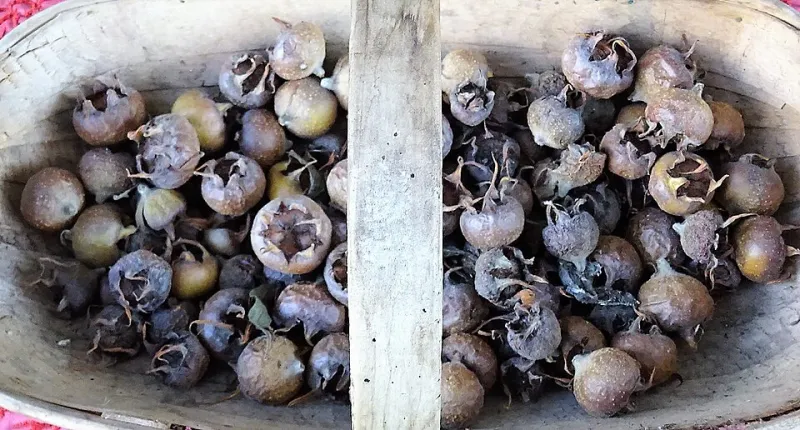
Photo: Rosser1954, CC BY-SA 4.0, via Wikimedia Commons
Most fruits ask you to be quick. The medlar asks you to be patient, and then it asks you to be brave. It hangs on the tree looking like a small, hard, brownish cricket ball, gets picked in November when it is still unyieldingly firm, and then sits about in a cold room until it goes soft, wrinkled and faintly alarming. That collapse has a name — bletting — and it is the point at which the whole thing becomes worth your time.
First, What Is It Actually?
The medlar is an old garden fruit, once so common in British orchards and cottage plots that you could barely move for them, now reduced to a handful of trees in churchyards, walled gardens, allotments and the odd National Trust parkland. It belongs to the rose family, which explains the tough little crown at the base of the fruit and the hard seeds rattling about inside. Older varieties you might come across include 'Nottingham' and 'Royal', both reliably hardy, both happy with a British winter.
Unripe, a medlar is a genuinely unpleasant thing to eat — tannic, chalky, mouth-drying. The Victorians thought the whole business was a bit of a joke and gave the fruit a nickname too rude to print here. Ignore that. Bletting is not rot in the sense you are worried about; it is an internal breakdown in which starches turn to sugar and the tannins soften, leaving flesh that tastes somewhere between apple puree, quince and a very mild fruit leather, with a tartaric edge that keeps it from being cloying.
Finding Them Without Being a Menace
If you have a medlar tree near you, you probably know someone who has been trying to give the fruit away for years. Ask first. A tree in a front garden, a community orchard or a pub car park still belongs to somebody, and a knock on the door goes a long way.
Pick in late October through November, when the fruit comes away from the branch with a gentle twist. Leave the ones high up and the ones on the outer tips — birds and squirrels get to them first in a hard winter and they need them more than your salad does. Never strip a tree, and never shake it.
If foraging is not an option, farmers' markets, decent greengrocers and the sort of garden centre that sells fruit trees will often have a few pounds going cheap, and specialist fruit nurseries sell them by post. Buying a small tree of your own is arguably the most sensible move: they crop reliably, tolerate most soils, and you will have a supply for decades.
How to Tell When It Is Ready
Bring the hard fruit home and lay it in a single layer, stalk down, in a cool, dark, airy spot — a shed, a garage, an unheated spare room, or a tray at the back of the kitchen counter if it is not too warm. A sheet of newspaper or a bed of straw is traditional. Check every few days.
The sequence goes like this: hard, then slightly yielding, then the skin darkens and wrinkles, then the whole fruit gives like a soft avocado and the flesh underneath turns to a rich brown paste. That is your moment. Smell it — you want gentle, cidery, faintly spiced; anything sharp or mouldy is a no. Keep bletted fruit in the fridge and use within a few days, or scoop the pulp and freeze it in small tubs.
To prepare: halve the fruit across the middle, scoop out the flesh with a spoon, and push it through a sieve to catch the skin and the hard seeds. Do not eat the seeds. What you are left with is a smooth, dense, tawny puree that behaves a bit like apple butter and tastes far more interesting.
Three Ways Into a Raw Kitchen
1. Medlar Cream That You Eat With a Spoon
Blend a mug of raw cashews (soaked overnight, or use the quick-soak method with just-boiled water for an hour) with water, a scrap of vanilla, a pinch of salt and a good spoonful of medlar pulp. Keep the medlar back until the end and taste as you go — a little goes a long way. Chill it for an hour. It sets softly, so serve it in small glasses with a few chopped toasted hazelnuts and a grating of nutmeg. This is the simplest possible conversion: Christmas pudding flavour, no oven, no steaming, no four-hour wait.
2. Shaved Salad With a Medlar Dressing
Whisk two tablespoons of medlar pulp with a tablespoon of cider vinegar, a teaspoon of English mustard, a pinch of salt and three tablespoons of cold-pressed rapeseed oil. It will look like a rather unglamorous brown emulsion and taste much better than it looks. Toss it through finely shaved chicory, raw Brussels leaves, a little celeriac and some sliced pear. Add walnuts. Eat with cold roast-adjacent things or on its own, at a table with the heating on and the window shut.
3. On the Festive Board
This is where the medlar earns its keep. The tartaric acidity cuts through the richness of a cultured cashew cheese or one of the sharper British plant-based cheeses — the kind with a rind and a bit of attitude — far better than a grape does. Halve a bletted medlar, scoop the pulp onto an oatcake, add a slice of something firm and salty, and finish with a crack of black pepper. Put a small bowl of the pulp on the board with a spoon and let people help themselves. Someone will ask what it is. You will get to tell them about bletting, and they will make a face, and then they will go back for more.
The Case, Briefly
We are asked constantly to buy fruit that is flawless, uniform and photogenic. The medlar fails every one of those tests and passes a more useful one: it is grown here, it needs no oven, it arrives exactly when the British larder is at its dullest, and it costs almost nothing if you know where to look. It also slows you down. You cannot impulse-buy a medlar and eat it on the way home. You have to wait, check, wait again, and then decide what to do with it.
That is not a hardship. That is the whole pleasure. Lay a few out on a tray this week and see what happens by the middle of December.